


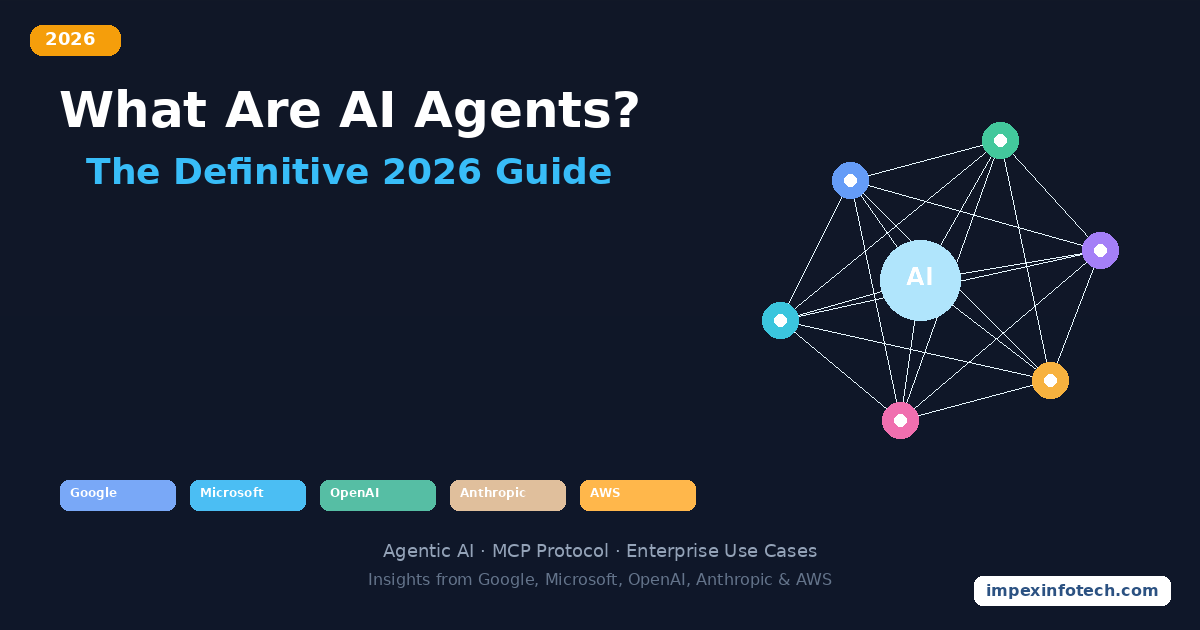
What Are AI Agents? The Definitive 2026 Guide to Agentic AI — From Google, Microsoft, OpenAI & Anthropic

⚡ Quick Answer
AI agents are autonomous software systems that perceive their environment, make decisions, take actions, and learn from outcomes — all without constant human input. Unlike traditional chatbots that wait for prompts, AI agents can plan multi-step workflows, use external tools (APIs, databases, browsers), and adapt their approach based on real-time feedback. In 2026, AI agents are the single biggest trend in enterprise AI. Google Cloud reports 340% growth in enterprise AI agent adoption in 2025. The tech giants — Google, Microsoft, OpenAI, Anthropic, and Amazon — have formed the Agentic AI Foundation (backed by the Linux Foundation) to create open standards for interoperable AI agents. Impex Infotech builds AI agent-powered solutions for eCommerce, customer support, and business automation.
🎯 Key Takeaways
- AI agents go beyond chatbots — they plan, reason, use tools, take actions, and learn from outcomes autonomously.
- The Agentic AI Foundation (Microsoft, Google, OpenAI, Anthropic + Linux Foundation) is creating open standards for AI agent interoperability.
- MCP (Model Context Protocol) by Anthropic is the emerging “USB-C for AI” — the standard way agents connect to external tools.
- Google Cloud reports 340% growth in enterprise AI agent adoption in 2025. The era of simple prompts is over.
- Key platforms: Google Vertex AI Agents, Microsoft Copilot Studio, OpenAI Assistants API, Anthropic Claude + MCP, Amazon Bedrock Agents.
- Impex Infotech builds AI agent-powered chatbots, search systems, and workflow automation for businesses in India, Australia, and the USA.
What Are AI Agents? (Clear Definition)
An AI agent is an autonomous software system that can perceive its environment, reason about goals, plan a sequence of actions, execute those actions using external tools, and learn from the outcomes — all with minimal human supervision.
Think of it this way: a chatbot answers one question at a time and waits. An AI agent receives a goal (“book me the cheapest flight to Sydney next Tuesday and add it to my calendar”) and then autonomously searches flights, compares prices, selects the best option, books it, and creates a calendar event — potentially using 5–10 different tools in the process.
AI Agents vs Chatbots vs AI Models — What’s the Difference?
| Feature | AI Model (LLM) | AI Chatbot | AI Agent |
|---|---|---|---|
| What it does | Generates text from prompts | Holds conversations | Completes tasks autonomously |
| Autonomy | None — needs human input | Low — responds to messages | High — plans and executes independently |
| Tool use | No | Limited (plugins) | Yes — APIs, databases, browsers, files |
| Multi-step reasoning | Single prompt/response | Multi-turn conversation | Multi-step planning and execution |
| Learning | Static after training | Session-based memory | Learns from outcomes, adapts strategy |
| Example | GPT-4 (raw model) | ChatGPT, Google Bard | GitHub Copilot, Claude Code, Google Workspace Agents |
How AI Agents Work: Architecture & Components
Every AI agent — whether built by Google, Microsoft, or a startup — shares four core components:
1. Perception Layer (Input)
The agent receives inputs from its environment: user instructions, API responses, sensor data, file contents, database queries, or web page content. This is how the agent “sees” its world.
2. Reasoning Engine (Brain)
Powered by a large language model (GPT-4, Claude, Gemini), the reasoning engine interprets inputs, breaks goals into sub-tasks, evaluates options, and decides on the next action. Advanced agents use chain-of-thought reasoning and can reconsider their approach if a step fails.
3. Action Layer (Tools)
The agent executes actions using external tools: calling APIs, writing files, sending emails, querying databases, browsing the web, or running code. This is what separates agents from chatbots — they can do things, not just say things.
4. Memory & Learning
Agents maintain short-term memory (current task context) and increasingly long-term memory (learning from past interactions). This allows them to improve over time and personalise their behaviour.
5 Types of AI Agents (With Real-World Examples)
LEVEL 1 Simple Reflex Agents
Act on predefined rules based on current input. No memory, no planning. Example: a thermostat that turns heating on when temperature drops below 20°C, or a spam filter that blocks emails matching specific patterns.
LEVEL 2 Model-Based Reflex Agents
Maintain an internal model of the world, allowing them to consider history and predict future states. Example: a robot vacuum that maps your house and avoids obstacles it’s learned about over time.
LEVEL 3 Goal-Based Agents
Plan actions toward a specific goal, choosing the most effective path. Example: a GPS navigation system that calculates the fastest route, rerouting when traffic conditions change.
LEVEL 4 Utility-Based Agents
Evaluate multiple possible outcomes and choose the action that maximises overall benefit. Example: a stock trading algorithm that balances risk, return, and portfolio diversification across thousands of options.
LEVEL 5 — FRONTIER Learning Agents
Improve their performance continuously by learning from experience and feedback. This is the frontier of AI agents in 2026 — systems like GitHub Copilot, Claude Code, Google Vertex AI Agents, and Microsoft Copilot Studio agents. They adapt, get smarter, and handle increasingly complex tasks over time.
The MCP Protocol — “USB-C for AI Agents”
One of the most significant developments in agentic AI is the Model Context Protocol (MCP) — an open standard originally created by Anthropic and now donated to the Linux Foundation’s Agentic AI Foundation.
MCP solves a fundamental problem: how do AI agents connect to the thousands of external tools, databases, APIs, and services they need to complete tasks? Before MCP, every integration required custom code. MCP standardises this — like how USB-C standardised device charging.
How MCP Works
- MCP Servers — expose tools and data sources (e.g., a Google Calendar MCP server, a GitHub MCP server).
- MCP Clients — AI agents that connect to these servers to use tools.
- Standardised protocol — any MCP-compatible agent can connect to any MCP server, regardless of which company built either side.
AnthropicOpenAIMicrosoftGoogleLinux Foundation
As TechCrunch reported in January 2026, MCP has become the connective tissue of the agentic AI ecosystem — with OpenAI, Microsoft, and Google all publicly embracing the standard.
What the Tech Giants Are Building: The AI Agent Race
Every major technology company is investing billions in AI agents in 2026. Here’s what each is building — and why it matters for businesses:
Google Vertex AI Agents & Workspace Agents
Google Cloud’s 2026 AI Agent Trends Report states the era of simple prompts is over — and calls AI agents the defining enterprise opportunity of 2026. Google’s Vertex AI Agents platform lets businesses build custom agents that orchestrate complex workflows across Gmail, Docs, Sheets, Calendar, and third-party tools. Google has also begun standing up managed MCP servers to connect AI agents to its products.
Key product: Google Agentspace — a no-code platform for building enterprise AI agents.
🔷 Microsoft
Microsoft Copilot Studio & Agent Builder
At Build 2025, Microsoft showcased Copilot Studio and an Agent Builder for Microsoft 365 Copilot — allowing businesses to create custom AI agents that connect to enterprise data and software via plugins and APIs, orchestrated within the Microsoft 365 ecosystem. Microsoft’s Power Platform now includes AI capabilities that let non-developers build agents with low-code tools.
Key product: Microsoft 365 Copilot Agents — agents embedded in Teams, Outlook, Word, and Excel.
🟢 OpenAI
OpenAI Assistants API & GPTs
OpenAI’s Assistants API provides the infrastructure for building AI agents that can use code interpretation, file search, and custom function calling. GPTs (custom ChatGPT configurations) are a consumer-friendly version of AI agents. OpenAI is reportedly developing a $1,000/month enterprise AI research agent — a system that acts like a personal research intern.
Key product: OpenAI Assistants API — the developer platform for building production AI agents.
🟤 Anthropic
Claude Code, MCP, & Agentic Workflows
Anthropic’s approach to agentic AI centres on two innovations: Claude Code (an autonomous coding agent that operates from the terminal) and MCP (the standard protocol for agent-tool connections). Claude Code can read entire codebases, write files, run tests, and create Git commits autonomously — making it the most sophisticated coding agent available in 2026.
Key product: Claude Code + MCP ecosystem — the backbone of agentic coding and enterprise AI agent infrastructure.
🟠 Amazon Web Services
Amazon Bedrock Agents
AWS Bedrock Agents let businesses build AI agents that autonomously plan, execute, and orchestrate tasks across enterprise systems. Bedrock supports agents powered by Claude, Llama, Mistral, and Amazon’s own Titan models — giving businesses model choice alongside agentic capabilities. Bedrock Agents integrate natively with AWS Lambda, S3, DynamoDB, and 200+ AWS services.
Key product: Amazon Bedrock Agents — multi-model agentic platform on AWS.
AI Agents Across 8 Industries in 2026
| Industry | AI Agent Use Cases | Example Platforms | Business Impact |
|---|---|---|---|
| Software Development | Code generation, review, testing, deployment | GitHub Copilot, Claude Code, Cursor | 2–3× developer productivity |
| eCommerce & Retail | Customer support, personalisation, inventory | Shopify Sidekick, Amazon Personalize | 15–30% higher conversion |
| Healthcare | Diagnosis support, data analysis, scheduling | Google Health AI, Epic + AI agents | 40% faster diagnosis |
| Financial Services | Fraud detection, underwriting, compliance | Stripe Radar, Bloomberg Terminal AI | 90%+ fraud detection |
| Manufacturing | Predictive maintenance, quality control | Siemens Industrial Copilot, AWS IoT | 35% less downtime |
| Education | Personalised tutoring, grading, admin | Khan Academy Khanmigo, Duolingo | 2× learning speed |
| Legal | Contract analysis, e-discovery, compliance | Harvey AI, Claude for legal | 10× faster review |
| Customer Service | 24/7 support, routing, resolution | Intercom Fin, Zendesk AI, Claude | 40% cost reduction |
How Impex Infotech Builds AI Agent Solutions
Impex Infotech has been building web applications and digital solutions for 15+ years. In 2026, we’re at the forefront of integrating AI agents into real business products for clients across India, Australia, and the USA.
What We Build with AI Agents
- AI-Powered Customer Support Agents — Chatbots built with OpenAI and Claude APIs that handle 80% of customer queries autonomously, integrated into Shopify and WordPress/WooCommerce stores.
- Intelligent Search Agents — AI search that understands natural language queries and returns personalised results, built into custom web applications.
- Workflow Automation Agents — Agents that automate business processes — order management, invoice processing, report generation — using PHP/Laravel backends connected to AI APIs via MCP.
- Content Generation Agents — AI systems that generate product descriptions, blog posts, and SEO metadata automatically for eCommerce and CMS platforms.
- Mobile AI Agents — Android and iOS apps with embedded AI assistants.
🎓 Expert Insight from Impex Infotech
“AI agents are not just for Silicon Valley giants. A mid-size eCommerce business in Mumbai, a law firm in Sydney, or a SaaS startup in Austin can all deploy AI agents today — using OpenAI, Claude, or Gemini APIs connected to their existing systems. The key is choosing the right partner who understands both the AI platforms and the business context. That’s what we deliver at Impex Infotech — AI agent solutions that solve real business problems, not tech demos.” — Impex Infotech Engineering Leadership
Best Practices for Deploying AI Agents (2026)
1. Start Small, Scale Fast
Don’t try to automate everything at once. Pick one high-volume, repetitive task (e.g., customer support queries) and deploy an AI agent there first. Measure results, then expand.
2. Keep Humans in the Loop
AI agents should escalate complex or sensitive decisions to human operators. Build approval workflows and override mechanisms into every agent deployment.
3. Use MCP for Tool Integration
Adopt the Model Context Protocol for connecting agents to your business tools. MCP is backed by Microsoft, Google, OpenAI, and Anthropic — it’s the emerging standard.
4. Ensure Data Privacy & Compliance
AI agents process business data — ensure compliance with GDPR (EU), India’s DPDP Act 2023, Australia’s Privacy Act, and CCPA (USA). Encrypt data in transit and at rest. Use role-based access controls.
5. Monitor, Measure, Iterate
Track agent performance with metrics: resolution rate, accuracy, cost per interaction, and user satisfaction. Use AI analytics to continuously optimise agent behaviour.
6. Choose Transparent, Explainable Agents
Deploy agents that can explain their reasoning. Anthropic’s Constitutional AI approach and Google’s responsible AI framework both prioritise transparency. For regulated industries (healthcare, finance, legal), explainability is non-negotiable.
The Future of AI Agents: 2026–2030 Outlook
- Multi-agent teams — Groups of specialised AI agents collaborating on complex tasks (e.g., one agent researches, one writes, one reviews).
- $1,000/month enterprise agents — Full-time AI “interns” that handle entire marketing stacks, research pipelines, or sales operations.
- Agent-to-agent communication — Agents from different companies negotiating, trading data, and coordinating via MCP and standardised protocols.
- On-device agents — Lightweight AI agents running locally on smartphones and laptops for offline task completion.
- Regulated agent certification — Government frameworks for certifying AI agents in healthcare, finance, and critical infrastructure.
🚀 Ready to Build AI Agent Solutions for Your Business?
Impex Infotech builds AI-powered chatbots, intelligent search, workflow automation, and custom AI agents for businesses in India, Australia, and the USA. Get your free consultation today.
Get a Free AI Agent Consultation →Frequently Asked Questions
Q1. What are AI agents?
AI agents are autonomous software systems that perceive their environment, make decisions, take actions, and learn from outcomes without constant human input. They can plan multi-step tasks, use external tools (APIs, databases, browsers), and adapt based on real-time feedback. Examples: GitHub Copilot, Claude Code, Google Workspace Agents.
Q2. What is the difference between AI agents and chatbots?
Chatbots respond to prompts one at a time. AI agents plan multi-step workflows, use external tools, execute actions autonomously, and adjust strategy based on results. Chatbots answer questions; agents complete tasks.
Q3. What are the 5 types of AI agents?
Simple reflex agents (rule-based), model-based reflex agents (maintain internal state), goal-based agents (plan toward objectives), utility-based agents (optimise outcomes), and learning agents (improve from experience). Most enterprise AI agents in 2026 are learning agents.
Q4. What is the MCP protocol?
Model Context Protocol (MCP) is an open standard by Anthropic (now under Linux Foundation) that lets AI agents connect to external tools through a standardised interface — like USB-C for AI. Adopted by OpenAI, Microsoft, Google, and hundreds of tool providers.
Q5. How are businesses using AI agents in 2026?
For customer support automation, code generation, document analysis, sales pipeline management, inventory forecasting, marketing automation, fraud detection, and workflow orchestration. Google Cloud reports 340% growth in enterprise AI agent adoption.
Q6. What is agentic AI?
Agentic AI refers to AI systems that act autonomously to accomplish goals — planning, using tools, making decisions, and learning with minimal human supervision. It’s the defining enterprise AI trend of 2026.
Q7. Can Impex Infotech build AI agent solutions?
Yes. Impex Infotech builds AI chatbots, intelligent search, workflow automation, and custom AI agents using OpenAI, Claude, and Gemini APIs for businesses in India, Australia, and the USA.
Q8. What is the Agentic AI Foundation?
A Linux Foundation-backed consortium (Microsoft, Google, OpenAI, Anthropic) creating open-source standards for AI agents, including MCP, to ensure interoperability and safety.
📚 References
- Google Cloud – AI Agent Trends 2026 Report – cloud.google.com
- Microsoft – Copilot Studio & Agent Builder – microsoft.com
- OpenAI – Assistants API Documentation – platform.openai.com
- Anthropic – Model Context Protocol (MCP) – modelcontextprotocol.io
- Linux Foundation – Agentic AI Foundation – linuxfoundation.org
- Amazon Web Services – Bedrock Agents – aws.amazon.com
- TechCrunch – In 2026, AI Moves from Hype to Pragmatism – techcrunch.com
- Stanford HAI – AI Index Report – aiindex.stanford.edu
- GitHub – What Are AI Agents? – github.com
Recent Posts
How to Deploy Projects on Vercel with GitHub: A Beginner’s Guide
How to Deploy Projects on Vercel with GitHub: A Beginner's Guide ⏱ 16 min read · Includes a section on...
Read More
How to Use AI for Social Media Marketing to Boost Engagement
How to Use AI for Social Media Marketing to Boost Engagement ⏱ 15 min read · Includes a step-by-step section...
Read More
SEO vs AEO vs GEO 2026 Does Your Business Need All Three
SEO vs AEO vs GEO in 2026: What Do They Mean and Does Your Business Need All Three? A plain...
Read MoreRecent Posts
How to Deploy Projects on Vercel with GitHub: A Beginner’s Guide
How to Deploy Projects on Vercel with GitHub: A Beginner's Guide ⏱ 16 min read · Includes a section on...
Read More
How to Use AI for Social Media Marketing to Boost Engagement
How to Use AI for Social Media Marketing to Boost Engagement ⏱ 15 min read · Includes a step-by-step section...
Read More
SEO vs AEO vs GEO 2026 Does Your Business Need All Three
SEO vs AEO vs GEO in 2026: What Do They Mean and Does Your Business Need All Three? A plain...
Read More