


What Is a Single Page Application (SPA)? The Complete Guide with Examples, Frameworks, and Best Practices (2026)
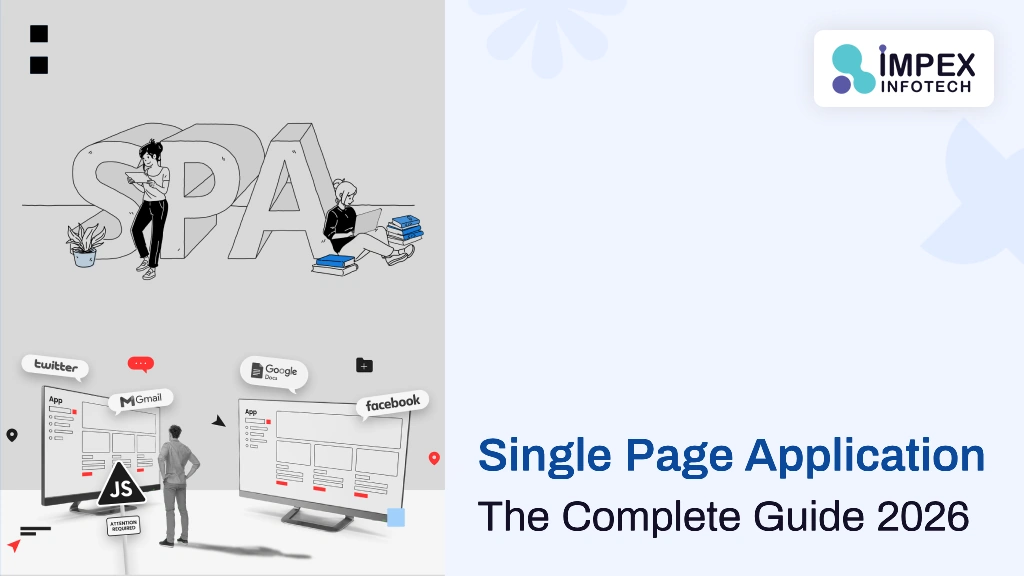
Single Page Applications power some of the most popular web products in the world — Gmail, Netflix, Trello, and Slack. This guide explains how SPAs work, compares them to traditional websites, covers the best frameworks, addresses SEO challenges, and helps you decide if a SPA is right for your project.
A Single Page Application (SPA) is a web application that loads a single HTML page and dynamically updates content using JavaScript, without full page reloads. SPAs communicate with servers via APIs (REST or GraphQL) and render content on the client side. Popular frameworks include React, Vue.js, Angular, and Svelte. SPAs deliver fast, app-like experiences but require SSR (Next.js, Nuxt.js) for proper SEO.
📑 Table of Contents
- What Is a Single Page Application?
- How SPAs Work: Client-Side Rendering Explained
- SPA vs MPA: Key Differences
- Real-World SPA Examples
- Best Frameworks for Building SPAs
- Advantages of Single Page Applications
- Disadvantages and Challenges
- SPA SEO: Solving the Indexing Problem
- When to Choose a SPA
- SPA Architecture: Frontend + Backend
- Performance Optimization for SPAs
- FAQs
What Is a Single Page Application?
A Single Page Application (SPA) is a web application that loads a single HTML document and dynamically updates the page content as the user interacts with it — without requiring full page reloads. Instead of the browser requesting a new HTML page from the server for every click, the SPA fetches only the data it needs (usually as JSON from an API) and updates just the parts of the page that change.
This creates a seamless, fast, app-like experience in the browser. SPAs feel instant because navigation does not trigger the traditional request-response cycle that causes brief white screens and loading delays between pages.
A traditional website is like changing TV channels — each click loads a completely new page. A Single Page Application is like scrolling through a streaming app — the interface stays loaded and content updates seamlessly without interruption.
How SPAs Work: Client-Side Rendering Explained
When a user first visits a SPA, the browser downloads the application’s HTML, CSS, and JavaScript bundle. After this initial load, all subsequent interactions are handled by JavaScript running in the browser (client-side rendering). The SPA uses a JavaScript router to manage URL changes and page transitions without requesting new HTML from the server.
When the application needs fresh data — such as loading a user’s inbox or fetching product details — it makes API calls (typically REST or GraphQL) to the backend server. The server responds with raw data (JSON), and the SPA’s JavaScript renders it into the user interface. This separation of frontend (presentation) and backend (data) is a core architectural principle of modern SPAs.
SPA vs MPA: Key Differences
| Aspect | SPA (Single Page App) | MPA (Multi-Page App) |
|---|---|---|
| Page Loading | Loads once, updates dynamically | Full page reload on every navigation |
| Speed (After Load) | Very fast (no reloads) | Slower (server round-trips) |
| Initial Load | Heavier (downloads JS bundle) | Lighter (only current page HTML) |
| SEO | Requires SSR/SSG solutions | SEO-friendly by default |
| User Experience | App-like, fluid transitions | Traditional page-to-page navigation |
| Development | Frontend framework + API backend | Server-rendered templates |
| Best For | Dashboards, tools, social apps | Content sites, blogs, e-commerce |
Real-World SPA Examples
- Gmail: The pioneering SPA — loads once, handles email interactions entirely client-side.
- Google Maps: Seamless map interactions, zooming, and routing without page reloads.
- Trello: Drag-and-drop task management with real-time updates.
- Netflix: Browse, search, and play content in a fluid, app-like interface.
- Twitter/X: Infinite scrolling feed with instant navigation between profiles and posts.
- Slack: Real-time messaging and channel switching without page reloads.
- Spotify Web Player: Music playback continues seamlessly as you navigate the interface.
- Figma: Full design tool running as a SPA in the browser.
Best Frameworks for Building SPAs
| Framework | Language | Backed By | Best For | SSR Solution |
|---|---|---|---|---|
| React | JavaScript/TypeScript | Meta | Most versatile, largest ecosystem | Next.js |
| Vue.js | JavaScript/TypeScript | Community | Gentle learning curve, flexible | Nuxt.js |
| Angular | TypeScript | Enterprise-scale applications | Angular Universal | |
| Svelte | JavaScript | Community | Smallest bundle, fastest runtime | SvelteKit |
| Solid.js | JavaScript/TypeScript | Community | Fine-grained reactivity, performance | SolidStart |
For most new SPA projects in 2026, Next.js (React) or Nuxt.js (Vue) are the recommended choices. They provide built-in SSR/SSG for SEO, file-based routing, API routes, and optimized performance — solving most traditional SPA limitations out of the box.
Advantages of Single Page Applications
- Fast, fluid UX: No page reloads. Instant navigation creates an app-like feel.
- Reduced server load: The server sends data (JSON), not rendered HTML — much lighter.
- Rich interactions: Complex animations, drag-and-drop, real-time updates are natural in SPAs.
- Offline capability: With Service Workers, SPAs can function offline or on poor connections.
- Code reuse: Frontend logic is decoupled from the backend — the same API serves web, mobile, and third-party apps.
- Smooth transitions: Page transitions can be animated without full DOM replacement.
Disadvantages and Challenges
- SEO complexity: Client-rendered content is harder for search engines to index. Requires SSR or prerendering.
- Larger initial load: The JavaScript bundle must download before the app becomes interactive.
- Browser history: Requires client-side routing to handle back/forward navigation correctly.
- Memory management: Long-running SPAs can accumulate memory leaks if not carefully managed.
- JavaScript dependency: The app is non-functional if JavaScript fails to load or is disabled.
- Security: Client-side code is exposed. Sensitive logic must remain on the server.
SPA SEO: Solving the Indexing Problem
The biggest criticism of SPAs has historically been poor SEO. Since SPAs render content via JavaScript, search engine crawlers (especially older ones) may not execute the JavaScript and therefore see an empty page. Modern solutions include:
- Server-Side Rendering (SSR): Next.js and Nuxt.js render the initial page on the server, sending fully-formed HTML to crawlers. The SPA takes over after the first load.
- Static Site Generation (SSG): Pre-renders pages at build time. Ideal for content that doesn’t change frequently.
- Incremental Static Regeneration (ISR): Combines SSG with on-demand updates — best of both worlds.
- Prerendering services: Tools like Prerender.io serve static snapshots to search engine bots.
With proper SSR implementation, SPAs can achieve the same SEO performance as traditional server-rendered websites.
At Impex Infotech, we build SPAs using Next.js as our primary framework. The combination of React’s component model, server-side rendering for SEO, and static generation for performance gives our clients the best of all worlds — fast, interactive applications that rank well in search engines.
When to Choose a SPA
Choose a SPA when:
- Building interactive applications (dashboards, project tools, collaboration platforms)
- Real-time updates are important (chat, notifications, live data)
- The app needs to feel fast and fluid (no page reload friction)
- You plan to build mobile apps from the same API (shared backend)
Choose a traditional MPA when:
- Content is primarily static (blogs, news sites, documentation)
- SEO is the top priority and you want simplicity
- The audience may have limited JavaScript support
- The project has a simple, content-focused structure
SPA Architecture: Frontend + Backend
SPAs follow a decoupled architecture where the frontend and backend are separate applications communicating through APIs. The frontend handles rendering, routing, and user interaction. The backend handles data storage, business logic, authentication, and API endpoints.
Common backend choices for SPAs include Node.js (Express, Fastify), Python (Django REST Framework, FastAPI), Ruby on Rails (API mode), and Go. The API layer typically serves JSON data over REST or GraphQL endpoints.
Performance Optimization for SPAs
- Code splitting: Load only the JavaScript needed for the current route. React.lazy() and dynamic imports reduce initial bundle size.
- Lazy loading: Defer loading of images, components, and routes until they are needed.
- Caching: Use Service Workers and HTTP caching for API responses and static assets.
- Bundle analysis: Use tools like webpack-bundle-analyzer to identify and eliminate bloated dependencies.
- Prefetching: Preload routes and data that users are likely to navigate to next.
- CDN delivery: Serve static assets from a CDN for global low-latency access.
🔑 Key Takeaways
- SPAs load once and update dynamically — creating fast, app-like web experiences.
- React (Next.js), Vue (Nuxt.js), Angular, and Svelte (SvelteKit) are the top SPA frameworks.
- SEO is solvable with SSR (Next.js/Nuxt.js), SSG, or prerendering.
- SPAs are ideal for interactive applications. MPAs are better for content-heavy, SEO-first sites.
- Performance optimization (code splitting, lazy loading, caching) is critical for SPA success.
- Modern meta-frameworks like Next.js and Nuxt.js solve most traditional SPA limitations.
Need a Fast, Modern Web Application?
Impex Infotech builds high-performance SPAs with React, Next.js, and Vue.js — optimized for speed, SEO, and scalability.
Start Your SPA Project →Frequently Asked Questions
A web app that loads one HTML page and updates content dynamically via JavaScript without full page reloads. Examples: Gmail, Trello, Netflix.
SPAs load once and update dynamically (faster). MPAs reload fully on each navigation (better default SEO, simpler architecture).
React (most popular), Vue.js, Angular, Svelte. Meta-frameworks: Next.js (React), Nuxt.js (Vue), SvelteKit.
Not with modern solutions. SSR (Next.js/Nuxt.js), SSG, and prerendering make SPAs fully SEO-friendly.
Gmail, Google Maps, Trello, Netflix, Twitter/X, Slack, Spotify Web, Figma.
For interactive apps (dashboards, tools, social platforms). Use MPAs for content-heavy sites (blogs, news, e-commerce catalogs).
SEO complexity, larger initial JS bundle, browser history management, memory leaks in long sessions, JavaScript dependency.
Yes. Use Next.js (SSR/SSG for React), Nuxt.js (for Vue), or prerendering services to ensure search engines can index content.
Recent Posts

Healthcare Booking System Development: The Complete Guide for 2026
Healthcare Booking System Development: The Complete Guide for 2026 ⏱ 20 min read ⚡ Quick Answer A healthcare booking system...
Read More
What Is a Single Page Application (SPA)? The Complete Guide with Examples, Frameworks, and Best Practices (2026)
What Is a Single Page Application (SPA)? The Complete Guide with Examples, Frameworks, and Best Practices (2026) ⏱ 14 min...
Read More
Metaverse Meaning in Simple Words: The Complete Guide for 2026
Metaverse Meaning in Simple Words: The Complete Guide for 2026 ⏱ 14 min read The metaverse is reshaping how we...
Read MoreRecent Posts
Healthcare Booking System Development: The Complete Guide for 2026
Healthcare Booking System Development: The Complete Guide for 2026 ⏱ 20 min read ⚡ Quick Answer A healthcare booking system...
Read More
What Is a Single Page Application (SPA)? The Complete Guide with Examples, Frameworks, and Best Practices (2026)
What Is a Single Page Application (SPA)? The Complete Guide with Examples, Frameworks, and Best Practices (2026) ⏱ 14 min...
Read More
Metaverse Meaning in Simple Words: The Complete Guide for 2026
Metaverse Meaning in Simple Words: The Complete Guide for 2026 ⏱ 14 min read The metaverse is reshaping how we...
Read More