


How to Build a Money Lending App in 2026: Features, Cost, and Compliance Guide

A money lending app is a digital platform that enables users to apply for loans, get AI-powered credit assessments, receive funds, and repay via automated EMIs — all from their smartphone. Development costs range from $50,000 to $250,000+ depending on complexity. Key requirements include KYC verification, credit scoring, loan management, payment gateway integration, and compliance with regulations like RBI Digital Lending Guidelines (India), ASIC (Australia), and CFPB/state licensing (USA).
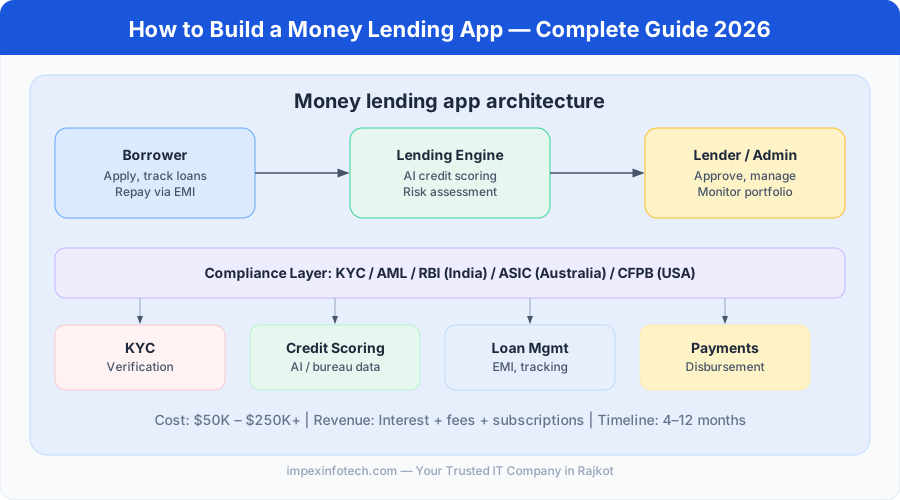
Digital lending is transforming how people access credit worldwide. From instant personal loans in India to peer-to-peer lending platforms in the USA and buy-now-pay-later services in Australia, the demand for mobile-first lending solutions has never been higher. India’s digital lending market alone is projected to reach $515 billion by 2030, growing at a staggering compound annual growth rate. In the USA, fintech lenders now originate over 50% of personal loans, and Australia’s BNPL market continues to expand rapidly.
For entrepreneurs, fintech startups, and financial institutions looking to enter the digital lending space, building a money lending app is one of the most lucrative yet complex software projects you can undertake. The complexity comes not just from features — but from regulatory compliance, security requirements, and the financial risk management systems that must be built into every layer of the application.
At Impex Infotech, a trusted IT company in Rajkot, our development team builds custom web and mobile applications for fintech businesses across the USA, Australia, and India. This guide covers everything you need to know about money lending app development — from features and compliance to AI credit scoring, costs, and monetization.
What Is a Money Lending App?
Money Lending App: A digital platform (mobile app or web application) that enables borrowers to apply for loans, undergo identity verification (KYC), receive automated credit assessments, get funds disbursed to their bank accounts, and repay through scheduled EMIs — all through a smartphone interface. The app connects borrowers with lenders (banks, NBFCs, P2P investors, or the platform itself) and automates the end-to-end lending workflow.
Modern lending apps go far beyond simple loan applications. They incorporate AI-driven credit scoring that analyzes hundreds of data points beyond traditional credit bureau scores, real-time identity verification using government databases (Aadhaar in India, SSN in USA), automated loan agreement generation with e-signatures, and smart repayment systems with auto-debit, reminders, and flexible restructuring options.
Digital Lending Market Opportunity in 2026
💡 India’s digital lending market is projected to reach $515 billion by 2030. Fintech lenders in the USA originate over 50% of personal loans. Australia’s BNPL market exceeds $20 billion annually.
- India: With 750+ million smartphone users, UPI-enabled instant disbursement, and Aadhaar-based eKYC, India is the world’s fastest-growing digital lending market. The RBI’s 2025 Digital Lending Directions have created a regulated, trust-based environment that favors compliant platforms.
- USA: Fintech lenders like SoFi, LendingClub, and Upstart have captured significant market share from traditional banks. State-by-state licensing, CFPB oversight, and Truth in Lending Act (TILA) compliance create a complex but lucrative regulatory landscape.
- Australia: Strong demand for personal loans, business lending, and BNPL services. ASIC (Australian Securities and Investments Commission) regulates lending practices, and the National Consumer Credit Protection Act governs responsible lending obligations.
Types of Money Lending Apps
| Type | How It Works | Examples | Best For |
|---|---|---|---|
| P2P Lending | Individual investors fund borrower loans | LendingClub, Faircent (India) | Marketplace model with investor returns |
| Personal Loan App | Platform lends directly from its balance sheet or NBFC partner | MoneyTap, CASHe, SoFi | Quick personal loans |
| Payday / Microfinance | Small, short-term loans until next paycheck | EarlySalary, Dave | Low-income, urgent needs |
| Business Lending | Working capital and growth financing for SMEs | Kabbage, Lendingkart | Small business owners |
| BNPL (Buy Now Pay Later) | Split purchases into installments at point of sale | Afterpay, Klarna, Simpl | E-commerce, retail |
| Mortgage Lending | Long-term home loan origination and processing | Rocket Mortgage, Better.com | Property purchase/refinancing |
Essential Features for a Money Lending App
Borrower-Side Features
- Registration and KYC verification: Phone/email signup with identity verification via government ID (Aadhaar, PAN, SSN, passport), selfie matching, and address proof — automated through APIs like Digilocker (India) or identity verification services like Jumio or Onfido.
- Loan application form: Simple, guided form capturing loan amount, tenure, purpose, income details, and employment information. Pre-fill wherever possible using verified data.
- AI-powered credit assessment: Real-time credit scoring using bureau data (CIBIL, Experian, Equifax), alternative data (bank statements, UPI history, spending patterns), and machine learning models that predict default probability.
- Loan offer and comparison: Display personalized loan offers with interest rates, EMI amounts, total payable, and tenure options. Let borrowers compare and select the best offer.
- E-signature and agreement: Digital loan agreement generation with legally valid e-signatures — eliminating paper documentation and enabling instant processing.
- Instant disbursement: Funds transferred directly to the borrower’s bank account via UPI, NEFT, IMPS (India), ACH (USA), or direct deposit (Australia) — ideally within minutes of approval.
- Repayment dashboard: View upcoming EMIs, payment history, remaining balance, prepayment options, and auto-debit status. Send smart reminders before due dates.
- Customer support: In-app chat, help center, and grievance redressal — mandatory under India’s RBI guidelines and good practice everywhere.
Lender / Admin Features
- Loan approval workflow: Configurable approval rules — auto-approve below certain thresholds, escalate to manual review above them. Support for multi-level approval chains.
- Portfolio dashboard: Real-time view of total loans disbursed, outstanding balance, repayment rates, default rates, and revenue metrics across all borrowers.
- Risk management tools: Early warning indicators for potential defaults, collection automation, restructuring workflows, and NPA (non-performing asset) tracking.
- Compliance and reporting: Automated generation of regulatory reports, credit bureau reporting, audit trails, and data retention compliance.
- User and role management: Admin, compliance officer, underwriter, collections agent — each with specific permissions and data access levels.
How a Loan Application Flows Through Your App
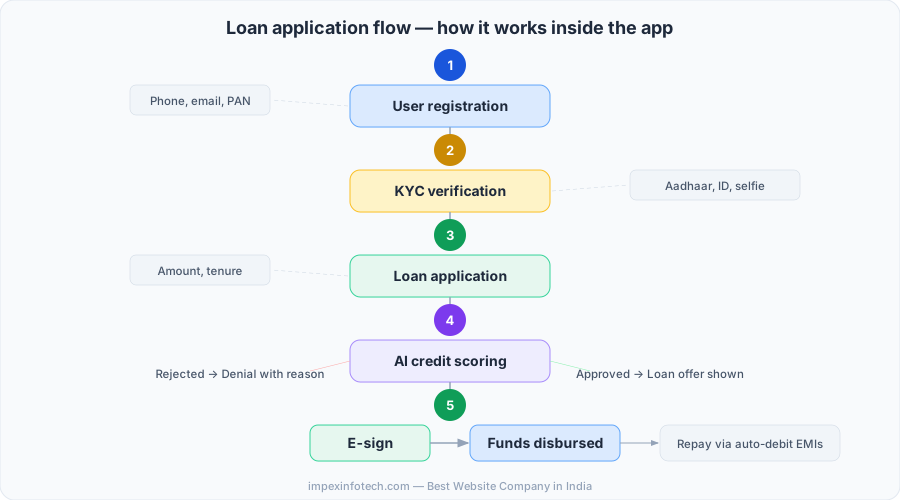
The biggest drop-off in lending apps happens at the KYC step. If identity verification takes more than 2 minutes or fails frequently, you lose borrowers to competitors. Invest in reliable KYC APIs (Aadhaar eKYC in India, Jumio or Persona globally) and design fallback flows for edge cases. A smooth KYC experience is the difference between a 30% and 70% application completion rate.
Step-by-Step Development Process
Market Research and Compliance Mapping
Research your target lending market, define your lending model (P2P, direct, BNPL), and map the regulatory requirements for every region you plan to operate in. In India, this means understanding the RBI Digital Lending Directions 2025. In the USA, map state-by-state licensing requirements. In Australia, review ASIC obligations. Budget 3–4 weeks.
UX/UI Design
Design the borrower application flow (registration → KYC → apply → offer → sign → disburse → repay) and the admin/lender dashboard. The borrower journey should feel as simple as ordering food online — minimal steps, clear progress indicators, and instant feedback. Budget 3–4 weeks.
Backend and API Development
Build the lending engine — credit scoring logic, loan product configuration, EMI calculation, interest accrual, disbursement workflows, and repayment processing. Develop RESTful APIs for the mobile app, admin dashboard, and third-party integrations. This is the most complex phase at 8–14 weeks.
Frontend and Mobile Development
Build the borrower-facing mobile app (React Native or Flutter for cross-platform) and the web-based admin dashboard (React.js). Ensure the app works smoothly on low-end devices and slow networks — critical for markets like India where borrowers may use budget smartphones. Budget 6–10 weeks.
Third-Party Integrations
Integrate KYC verification APIs, credit bureau APIs (CIBIL, Experian), payment gateways (Razorpay, Stripe), e-signature providers (DigiSign, DocuSign), bank account verification, and notification services. Each integration adds 1–3 weeks depending on API complexity.
Security and Compliance Implementation
Implement end-to-end encryption, role-based access control, audit logging, data residency compliance (India requires data stored on Indian servers), PCI DSS for payment handling, and fraud detection mechanisms. Budget 3–4 weeks.
Testing, Audit, and Launch
Run comprehensive testing — functional, security penetration, load (simulate thousands of concurrent loan applications), and compliance audit. Obtain necessary licenses and approvals. Soft launch with a limited user base, monitor closely, then scale. Budget 3–4 weeks for testing plus licensing timelines.
Recommended Technology Stack
| Layer | MVP / Startup | Enterprise Scale |
|---|---|---|
| Mobile App | React Native, Flutter | Native iOS (Swift) + Android (Kotlin) |
| Backend | Node.js (Express), Python (Django) | Java Spring Boot, Python (FastAPI), Go |
| Database | PostgreSQL, MongoDB | PostgreSQL + Redis + TimescaleDB |
| Cloud | AWS, Azure | AWS (Mumbai/Sydney/US regions) with compliance |
| KYC / Identity | Aadhaar eKYC, Jumio, Onfido | Multi-provider with fallback |
| Credit Bureau | CIBIL API, Experian API | Multi-bureau with custom scoring overlay |
| Payments | Razorpay, Stripe, UPI | Multiple gateways + NACH mandate + ACH |
| AI/ML | OpenAI / pre-built scoring models | Custom ML models (Python, TensorFlow) |
| Notifications | Twilio, MSG91 | Multi-channel (SMS + Push + WhatsApp + Email) |
Regulatory Compliance: USA, India, Australia
Lending is one of the most heavily regulated sectors in every country. Non-compliance can result in app bans, heavy fines, and criminal liability. Here are the key requirements for each target market:
India — RBI Digital Lending Directions 2025
- All lending must be done through or in partnership with an RBI-regulated entity (bank or NBFC). Fintech apps operate as Lending Service Providers (LSPs).
- Loan disbursement and repayment must flow directly between the RE and the borrower — no pass-through accounts via the app.
- All borrower data must be stored on servers in India. If processed overseas, it must be deleted within 24 hours.
- Full transparency required: display annual percentage rate (APR), all fees, and grievance redressal details upfront before loan agreement.
- Apps must be registered on the RBI CIMS portal and the digital lending app directory.
USA — State Licensing + Federal Oversight
- Lending requires state-by-state money lender licenses in most states — there is no single federal lending license for fintechs.
- Must comply with the Truth in Lending Act (TILA) — clearly disclose APR, finance charges, total payments, and late fee policies.
- The CFPB (Consumer Financial Protection Bureau) oversees consumer lending practices at the federal level.
- Fair lending laws (Equal Credit Opportunity Act) prohibit discrimination based on race, gender, age, or other protected characteristics in credit decisions.
- If using AI for credit scoring, must ensure model explainability — borrowers have the right to know why they were denied.
Australia — ASIC + Responsible Lending
- Requires an Australian Credit Licence (ACL) from ASIC to offer consumer lending.
- Must comply with National Consumer Credit Protection Act (NCCP) — responsible lending obligations require assessing whether the loan is “not unsuitable” for the borrower.
- BNPL products are now subject to regulation under the updated credit laws — no longer exempt.
- Must comply with the Australian Privacy Principles (APPs) for handling personal and financial data.
Never launch a lending app without legal counsel specializing in financial regulation for your target market. The regulatory landscape changes frequently — India’s RBI updates guidelines almost annually, and US state laws vary dramatically. Build compliance into your architecture from day one; retrofitting is 5–10x more expensive than building it correctly upfront.
AI-Powered Credit Scoring: The Competitive Edge
Traditional credit scoring relies on bureau data (CIBIL, Experian) which covers only a portion of the population — especially in markets like India where hundreds of millions of adults are “credit invisible.” AI-powered alternative credit scoring is what separates modern lending apps from legacy systems:
- Bank statement analysis: ML models analyze 3–6 months of transaction data to assess income stability, spending patterns, existing obligations, and saving behavior.
- UPI/payment history: In India, UPI transaction patterns reveal financial behavior that traditional bureau scores miss entirely.
- Device and behavioral data: App usage patterns, phone model, location stability, and other non-financial signals contribute to risk assessment (with user consent).
- Social and employment verification: LinkedIn profile verification, employer confirmation, and professional network analysis add data points for thin-file borrowers.
- Ensemble scoring: Combining bureau data with alternative data through ensemble ML models improves prediction accuracy by 20–40% compared to bureau scores alone.
How to Monetize a Lending App
| Revenue Stream | How It Works | Typical Range |
|---|---|---|
| Interest Income | Interest charged on loan principal | 12%–36% APR (varies by market/risk) |
| Processing Fees | One-time fee charged at disbursement | 1%–5% of loan amount |
| Late Payment Fees | Penalty for missed EMI payments | Fixed amount or % of overdue EMI |
| Subscription (Lender) | P2P platforms charge investors for premium access | $10–$100/month |
| Lead Generation | Sell qualified leads to partner banks/NBFCs | $5–$50 per qualified lead |
| Insurance Cross-sell | Offer credit protection or life insurance with loans | Commission-based |
Development Cost Breakdown
| Project Scope | Estimated Cost | Timeline | Includes |
|---|---|---|---|
| MVP | $50,000 – $100,000 | 4–6 months | Core lending flow, KYC, basic scoring, single platform |
| Full-Featured Platform | $100,000 – $180,000 | 6–9 months | iOS + Android, AI scoring, multi-product, admin dashboard |
| Enterprise Solution | $180,000 – $300,000+ | 9–14 months | Multi-region compliance, advanced AI, analytics, white-label |
Annual maintenance typically runs 15–25% of the initial build cost, covering security patches, regulatory updates, infrastructure scaling, and feature enhancements. Third-party API costs (KYC, credit bureau, SMS) add $2,000–$15,000/month depending on transaction volume.
Best Practices and Security
- Encrypt everything. All personal and financial data must be encrypted in transit (TLS 1.3) and at rest (AES-256). No exceptions.
- Implement multi-factor authentication. Biometric (fingerprint, face) + OTP for all sensitive operations like loan applications and fund transfers.
- Build for low-end devices. In India, many borrowers use budget smartphones with limited storage and slow networks. Optimize app size (under 25MB) and support offline-first patterns.
- Automate compliance reporting. Generate regulatory reports automatically rather than manually — reduces errors and saves hundreds of hours annually.
- Design for transparency. Show borrowers the full cost of their loan upfront — APR, total interest, all fees, and total payable amount. This is legally required in most markets and builds trust.
- Build grievance redressal into the app. Mandatory in India under RBI guidelines. Good practice everywhere — in-app complaint tracking with response SLAs.
- Start with one market, then expand. Compliance is market-specific. Master one regulatory environment before entering another.
At Impex Infotech, our web application development team helps fintech startups and lending institutions build compliant, scalable digital platforms. We understand that lending app development is not just a technology project — it is a financial product that requires regulatory expertise baked into every line of code.
- Money lending app development costs $50,000–$300,000+ depending on features, compliance scope, and target markets.
- Regulatory compliance is non-negotiable — RBI (India), CFPB + state licensing (USA), ASIC (Australia) each have specific requirements.
- AI-powered credit scoring using alternative data is the key differentiator for modern lending apps.
- KYC verification is the #1 drop-off point — invest in fast, reliable identity verification APIs.
- Revenue comes from interest income, processing fees, late fees, and cross-selling financial products.
- Data must be stored in India for apps operating under RBI regulations.
- Build compliance and encryption into the architecture from day one — retrofitting is 5–10x more expensive.
- Start with one market and one lending product, then expand after establishing regulatory and operational foundation.
Ready to Build Your Lending Platform?
Impex Infotech develops custom fintech web applications and mobile platforms for lending businesses across the USA, Australia, and India. From MVP to enterprise-scale — we build compliant, secure, and scalable lending solutions.
Get a Free ConsultationFrequently Asked Questions
A basic lending app MVP costs $50,000–$100,000 and takes 4–6 months. A full-featured platform with AI scoring and multi-platform support costs $100,000–$180,000. Enterprise solutions with multi-region compliance exceed $180,000–$300,000+. Annual maintenance adds 15–25% of the build cost.
You cannot lend directly as a fintech app in India. All lending must go through an RBI-regulated entity — either a bank or NBFC. Fintech apps operate as Lending Service Providers (LSPs) in partnership with regulated entities. Your app and all partner apps must be registered on the RBI CIMS portal.
React Native or Flutter for cross-platform mobile apps, Node.js or Python for the backend, PostgreSQL for the database, and AWS for cloud hosting. Integrate CIBIL/Experian APIs for credit scoring, Razorpay or Stripe for payments, and Aadhaar eKYC or Jumio for identity verification.
AI models analyze hundreds of data points beyond traditional credit bureau scores — including bank statement patterns, UPI transaction history, spending behavior, employment verification, and device signals. Ensemble models combining bureau and alternative data improve prediction accuracy by 20–40% compared to bureau scores alone.
Yes, but each market has different regulatory requirements. India requires RBI-regulated entity partnerships and Indian data storage. The USA requires state-by-state licensing. Australia requires an ASIC credit licence. Start with one market, establish compliance, then expand. The tech architecture should be designed for multi-region support from the start.
Primary revenue comes from interest income on loans disbursed (12–36% APR depending on market and risk). Additional revenue streams include processing fees (1–5% of loan amount), late payment penalties, insurance cross-selling commissions, and lead generation fees for partner institutions.
An MVP takes 4–6 months. A full platform with AI scoring, compliance automation, and multi-platform support takes 6–9 months. Enterprise solutions with multi-region compliance and advanced analytics take 9–14 months. Regulatory licensing and approvals may add additional time beyond development.
End-to-end encryption (TLS 1.3 in transit, AES-256 at rest), multi-factor authentication with biometrics, role-based access control, comprehensive audit logging, PCI DSS compliance for payment processing, fraud detection systems, and regular penetration testing. In India, data must be stored on servers located within India.
References & Further Reading
Recent Posts
How to Deploy Projects on Vercel with GitHub: A Beginner’s Guide
How to Deploy Projects on Vercel with GitHub: A Beginner's Guide ⏱ 16 min read · Includes a section on...
Read More
How to Use AI for Social Media Marketing to Boost Engagement
How to Use AI for Social Media Marketing to Boost Engagement ⏱ 15 min read · Includes a step-by-step section...
Read More
SEO vs AEO vs GEO 2026 Does Your Business Need All Three
SEO vs AEO vs GEO in 2026: What Do They Mean and Does Your Business Need All Three? A plain...
Read MoreRecent Posts
How to Deploy Projects on Vercel with GitHub: A Beginner’s Guide
How to Deploy Projects on Vercel with GitHub: A Beginner's Guide ⏱ 16 min read · Includes a section on...
Read More
How to Use AI for Social Media Marketing to Boost Engagement
How to Use AI for Social Media Marketing to Boost Engagement ⏱ 15 min read · Includes a step-by-step section...
Read More
SEO vs AEO vs GEO 2026 Does Your Business Need All Three
SEO vs AEO vs GEO in 2026: What Do They Mean and Does Your Business Need All Three? A plain...
Read More