


Best Inventory Management Software Solutions for Small Business in 2026: Pricing, Features and When to Go Custom (USA & India)
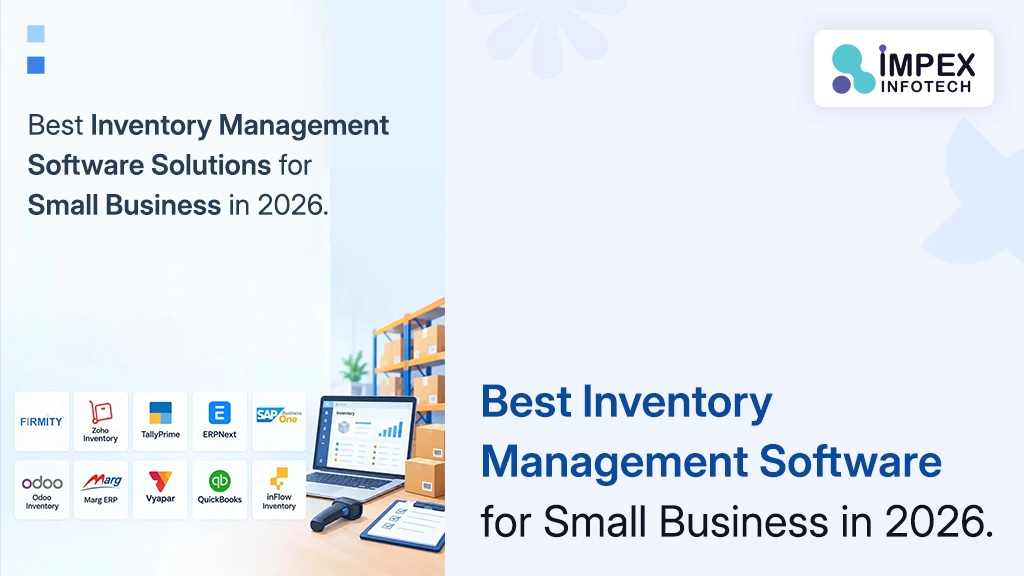
For most small businesses an off-the-shelf tool is the right call. Zoho Inventory is the best all-round value in the US (from $29 per month, billed annually) and India (from ₹999), with a real free plan. Sortly is the simplest phone-based tracker. Shopify, Square for Retail and QuickBooks Online Plus fit if you already sell or keep books there. Katana and Fishbowl suit makers, Cin7 Core suits distributors, Vyapar and TallyPrime suit GST-registered Indian firms, and NetSuite is the enterprise step. Go custom only when your process is the product or no vendor connects to the systems that matter.
🎯 Key Takeaways
- Free plans are real but tight: Zoho Inventory allows 50 orders a month, Sortly 100 items, Katana 30 SKUs.
- The pricing unit matters more than the headline price: Zoho caps orders, Cin7 Core and Fishbowl count users, Odoo and NetSuite bill per user, Square bills per location.
- India needs GST e-invoicing (mandatory above ₹5 crore turnover since 1 August 2023) and e-way bills; the US needs sales-tax automation and QuickBooks Online sync.
- Over three years a mid-tier subscription usually costs a fraction of a custom build. Custom wins when the workflow is unusual, an integration is missing, or per-seat pricing passes the cost of owning the software.
01What Inventory Management Software Does (and Doesn’t Do)
Inventory management software keeps one accurate count of what you own, where it is, what it cost and when to buy more. Everything else is built on that count.
The job is the same in Ohio and Jamnagar: record stock in, record stock out, keep the number between them honest. Good small business inventory management software adds reorder points, purchase orders, barcode scanning, multi-location transfers and a sync with sales channels and accounting so the count updates itself. What it does not do is fix a bad process: if goods leave without a scan, no software will know, and if three people keep three spreadsheets, a subscription gives you a fourth.
The scale is not small. The US Census Bureau’s advance indicators report for August 2026 put wholesale inventories at $965.7 billion and retail inventories at $881.6 billion. The SBA Office of Advocacy counted 36,207,130 US small businesses in February 2026, 99.9% of all firms. In India, a government statement reported by IANS in May 2026 put Udyam and Udyam Assist registrations above 7.9 crore enterprises. Most hold stock; most still count it by hand.
02How We Compared These Inventory Management Solutions
We shortlisted inventory management software solutions a small or mid-sized business in the US or India (and, secondarily, Canada or Australia) could run in 2026 without an enterprise budget, grouped them into five buckets (starters, ecommerce and retail, manufacturing and distribution, India-specific, enterprise) and compared entry cost and pricing unit; accounting and channel sync as documented by the vendor; US sales-tax and India GST handling; scanning, multi-location and manufacturing features; and what the bill does at 3,000 orders a month.
Every plan, limit and price comes from the vendor’s own pricing or help page, checked on 28 October 2026, in USD or INR as displayed; a bare “$” is treated as US dollars. Zoho, inFlow and Fishbowl show annual-billing rates, Cin7 Core monthly; Vyapar and TallyPrime exclude 18% GST. No hands-on tests were run, this article is not sponsored, and nobody paid for placement.
03All 12 Tools at a Glance
| Tool | Group | Free plan | Paid from | Pricing unit | Accounting sync | Best for |
|---|---|---|---|---|---|---|
| Zoho Inventory | Starter / ecommerce | Yes (50 orders, 1 user) | $29/mo billed annually (US); ₹999/mo billed annually (India) | Per organisation, order caps | Zoho Books, QuickBooks Online | Best all-round value in both markets |
| Sortly | Starter | Yes (100 items, 1 user) | $49/mo list ($24/mo first year) | Per plan, item caps | None listed | Visual stock tracking by phone |
| inFlow Inventory | Starter / distribution | 14-day trial only | $99/mo billed annually (Lite) | Per plan, team members and locations | QuickBooks Online | Small wholesalers and B2B sellers |
| QuickBooks Online Plus | Accounting with inventory | No (promo pricing) | $140/mo (Plus) | Per plan, user caps | Native | US firms already on QuickBooks |
| Shopify | Ecommerce | No (trial) | $29/mo billed yearly, $39 monthly (Basic) | Per store, 10 locations | Via apps | Online stores selling their own stock |
| Square for Retail | Retail POS | Yes ($0 software, processing fees) | $89/mo per location (Plus) | Per location | Via integrations | Physical shops in the US |
| Katana | Manufacturing | Yes (30 SKUs, unlimited users) | Custom (Advantage, annual contract) | Contract | QuickBooks Online, Xero (listed) | Small makers who want MRP without ERP |
| Cin7 Core | Distribution / ecommerce | No | $349/mo billed monthly (Standard) | Per plan, users and orders/year | Xero, QuickBooks Online | Multichannel sellers with volume |
| Fishbowl | Manufacturing / warehouse | No | $229/mo billed annually (Essentials) | Per plan, user counts | QuickBooks Online, Xero; Desktop on Advanced | QuickBooks-centric manufacturers |
| Vyapar | India-specific | Yes (Silver desktop shown at ₹0) | ₹308/mo billed annually + 18% GST (Gold desktop) | Per plan, per platform | Built-in GST books | Indian micro and small traders |
| TallyPrime | India-specific | No (trial) | ₹750/mo rental or ₹22,500 one-time + 18% GST (Single User) | Per licence (single/multi user) | Native | Indian SMEs whose CA uses Tally |
| NetSuite | Enterprise ERP | No | Quote (annual licence + implementation) | Platform + modules + users | Native | Companies outgrowing everything above |
04The 12 Best Inventory Management Software Solutions
1. Zoho Inventory: the best value in both the US and India
Zoho Inventory is cloud inventory and order management priced for businesses most rivals ignore, linked to Zoho Books and connected to QuickBooks Online, Shopify and Amazon.
- Strengths: a usable free plan; composite items, drop-shipment and back-ordering on every tier; serial and batch tracking, barcode generation and stock counting from Premium in India; e-way bills on the Indian edition.
- Limitations: order and location caps, only two users on US plans below Enterprise, and only annual prices displayed. The QuickBooks Online sync is mostly one way, and Avalara works only for US or Canadian organisations.
- Pricing (US, per organisation per month, billed annually): Free (50 orders, 1 user, 2 locations); Standard $29 (500 orders, 2 users, 2 locations); Professional $79 (3,000 orders); Premium $129 (7,500 orders); Enterprise $249 (15,000 orders, 7 users, 10 locations).
- Pricing (India, same basis, excluding GST): Free (50 orders, 1 user, 1 location); Standard ₹999 (500 orders, 3 users); Premium ₹2,299 (3,000 orders, 5 users); Plus ₹4,999 (7,500 orders, 10 users); Enterprise ₹7,499 (15,000 orders, 10 locations).
- Choose it if: your volume fits an order-capped plan and you want channels and accounting on one bill.
2. Sortly: the simplest way to see what you own
Sortly is a visual stock tracker: photograph items, group them by location, print labels, scan with a phone to move or count. It does not manage sales orders, which is why workshops and service businesses like it.
- Strengths: a free plan with no trial needed; in-app barcode and QR scanning plus third-party scanner support; custom labels on paid plans; activity history.
- Limitations: item caps (100 free, 500, 2,000, 5,000) and small user counts (1, 2, 5, 8); no order management or accounting integration listed.
- Pricing (USD): Free; Advanced $49/month list, shown at $24/month for the first year ($288/year); Ultra $149 list, $74 first year; Premium $299 list, $149 first year; Enterprise by quote. The 50% discount is first-year only; a 20% yearly discount applies after.
3. inFlow Inventory: B2B order management with no order caps
inFlow sells separate Inventory, Manufacturing and Stockroom lines, limited by team members and locations rather than orders; Inventory and Manufacturing plans advertise unlimited products, sales and purchases.
- Strengths: Shopify, Amazon and QuickBooks Online included; wholesale pricing schemes; a 14-day trial with no card; prices in USD, CAD, GBP and EUR.
- Limitations: no free plan; Lite allows two team members and one location; monthly billing is dearer ($129 versus $99); Stockroom excludes the integrations.
- Pricing (USD per month, billed annually): Inventory Lite $99 (2 members, 1 location), Core $299 (5, 5), Pro $499 (10, unlimited), Max $699 (20, unlimited); Manufacturing from $169 to $859; Stockroom from $69.
4. QuickBooks Online Plus and Advanced: inventory inside the US bookkeeping standard
For a US business already on QuickBooks Online, the cheapest inventory system is often the one you have: FIFO inventory tracking and stock-level monitoring are included on Plus and above.
- Strengths: books and stock in one system, so cost of goods sold flows straight to the P&L; five users on Plus, 25 on Advanced; most dedicated tools here sync to it.
- Limitations: accounting first: no bills of materials, no warehouse workflows, no multichannel sync without apps.
- Pricing (USD per month): Simple Start $38, Essentials $85, Plus $140, Advanced $340, with a “save 50% for 3 months” promotion at the time of checking.
5. Shopify built-in inventory: enough for most online stores (Stocky has gone)
Shopify tracks inventory per location on every plan: 10 locations on Basic, Grow and Advanced, 200 on Plus. The Stocky app older guides recommend is gone; Shopify’s help centre says it “will no longer be available after August 31st, 2026”.
- Strengths: inventory, orders and storefront in one system, plus an App Store that fills gaps (Zoho Inventory, inFlow and Katana list Shopify integrations). See our Shopify vs WooCommerce comparison.
- Limitations: no bills of materials or supplier management; online card rates (2.9% + 30¢ on Basic, 2.7% on Grow, 2.5% on Advanced) are part of the real cost.
- Pricing (USD per month): Basic $39 monthly or $29 billed yearly; Grow $105 or $79; Advanced $399 or $299; Plus from $2,300.
- Choose it if: your stock exists to be sold online. For a custom storefront on top, see our Shopify development service.
6. Square for Retail: a free POS with paid inventory depth
Square for Retail is the easiest start for a US shop: no monthly software fee on Free, with Plus unlocking the inventory depth a growing retailer needs.
- Strengths: cross-location stock sync on every plan; Plus adds barcode labels, purchase orders, vendor management, a counting tool, transfers and smart stock forecasts, with a 30-day trial.
- Limitations: Plus is priced per location; the real cost is processing (in person 2.6% + 10¢ on Free, 2.5% + 10¢ on Plus; online 2.9% + 30¢).
- Pricing: Free $0; Plus $89 per month per location; Premium custom, available if you process more than $250K a year. The page shows “$” without naming a currency.
7. Katana: manufacturing inventory with a free tier
Katana is a cloud manufacturing and inventory platform for small makers. Its 2026 pricing is unusual: a Free plan and a custom-priced Advantage plan, nothing between.
- Strengths: Free includes “all Katana features”, unlimited users and locations and API access, with 15 days to test unlimited SKUs; Advantage adds an implementation manager, 24/7 support and custom integrations.
- Limitations: Free is capped at 30 SKUs and only Shopify integrates with it; QuickBooks Online, Xero and Amazon are listed without plan detail.
- Pricing: Free “$0, no card required”; Advantage custom pricing on one annual contract.
8. Cin7 Core: multichannel inventory for growing distributors
Cin7 Core is the step up from Zoho or inFlow for product businesses whose volume, users and channels grow together.
- Strengths: Xero and QuickBooks Online in every plan; unlimited inventory locations; an Avalara integration for US sales tax; Advanced Warehouse Management on Advanced (add-on on Pro).
- Limitations: no free plan; caps on sales orders per year and integration count; Standard warehouse management supports one warehouse location; onboarding is not priced.
- Pricing (USD per month, billed monthly, excludes tax): Standard $349 (5 users, 6,000 sale orders a year, 2 integrations); Pro $599 (10 users, 24,000 orders, 4); Advanced $1,199 (15 users, 120,000 orders, 6). Cin7 Omni is quote-based.
9. Fishbowl: QuickBooks-first inventory and manufacturing
Fishbowl built its reputation as the inventory and manufacturing add-on for QuickBooks, and now sells a cloud Inventory line plus Fishbowl Advanced by quote.
- Strengths: QuickBooks Online and Xero sync and mobile scanning from Essentials; pick, receive and ship, sales-tax automation and unlimited warehouses from Growth; forecasting and lot traceability on Scale. Advanced Manufacturing adds bills of materials, MRP and work orders.
- Limitations: Inventory plans “do not include manufacturing (BOMs, work orders, MRP)”. An implementation package is required and not priced; migration excludes history; rates are labelled “illustrative”.
- Pricing (USD per month, billed annually): Essentials $229 (2 users); Growth $429 (5); Scale $729 (10). Advanced Manufacturing from $675 and Advanced Warehouse from $595, final price by quote.
10. Vyapar: GST billing and stock for Indian micro and small businesses
Vyapar is a GST-native billing, accounting and inventory app for Indian traders and retailers, running on Android and Windows.
- Strengths: GST invoices and GSTR reports; stock tracking with reorder points and expiry alerts; e-way bill and e-invoice generation on desktop Gold; barcode import and godown management on Retail Pro.
- Limitations: billing-first, not a warehouse system; no Shopify or Amazon sync listed; the dedicated pricing page returned only metadata when we checked, so confirm before buying.
- Pricing (INR per month, billed annually, plus 18% GST, as shown on vyaparapp.in): Desktop Silver ₹0; Desktop Gold ₹308 (about ₹3,696 a year); Desktop Retail Pro ₹308; Desktop Platinum ₹833 (about ₹9,996 a year). Mobile plans were displayed at ₹0.
11. TallyPrime: the Indian SME standard, with inventory included
TallyPrime is the accounting system most Indian chartered accountants use; inventory, e-invoicing and e-way bills are standard, and “every plan comes fully loaded with all features”. You pay for licence type and user count.
- Strengths: inventory and GST compliance in the ledger your accountant already uses; a choice of perpetual licence or monthly rental.
- Limitations: desktop-first, with no native Shopify or Amazon sync; warehouse workflows are less guided than a dedicated WMS; TSS renewals recur on perpetual licences.
- Pricing (INR, plus 18% GST): perpetual Single User ₹22,500, Multi User ₹67,500. Rental: Single User ₹750 per month or ₹9,000 per year (shown discounted to ₹8,100); Multi User ₹2,250 per month or ₹27,000 per year. TSS renewal: Silver ₹4,500, Gold ₹13,500 per year.
12. NetSuite: when inventory is one module of an ERP
Oracle NetSuite is the cloud ERP small businesses graduate to. Inventory management is included in the platform licence, with multi-location fulfilment rules, Smart Count cycle counting, demand-based replenishment, and lot and serial traceability.
- Strengths: one database for finance, inventory, orders and CRM; multi-entity and multi-currency by design; a large partner ecosystem.
- Limitations: no public prices; an annual licence of platform, modules and users, plus a one-time implementation fee.
- Pricing: by quote.
- Choose it if: you are consolidating several systems, entities or countries. Our list of the top ERP development companies in 2026 covers implementation partners.
Odoo’s “One App Free” plan is $0 for one app with unlimited users, and Inventory can be that app. A second app moves you to per-user pricing: Odoo’s page showed US$31.10 and US$38.90 for Standard and US$46.70 and US$58.40 for Custom depending on the yearly/monthly toggle, so confirm which applies. Custom adds on-premise hosting, Odoo Studio and the external API.
05India: GST, E-Invoicing and the Tally/Zoho/Vyapar Ecosystem
Indian inventory software is judged first on compliance: a perfect count that cannot produce a GST invoice, e-way bill or IRN-stamped e-invoice will be abandoned within a quarter.
- GST invoicing: every sale needs the right HSN or SAC code, the CGST/SGST or IGST split and place-of-supply logic. Vyapar, TallyPrime and Zoho Inventory India handle this natively; US-centric tools do not.
- E-invoicing threshold: Notification 10/2023-Central Tax of 10 May 2023, on the GST Council site, extended e-invoicing to taxpayers with aggregate turnover exceeding ₹5 crore from 1 August 2023. Near that line, make sure the software generates the IRN and QR code itself. TallyPrime lists e-invoicing as standard; Vyapar lists it on desktop Gold.
- E-way bills: Zoho Inventory India, Tally and Vyapar all list e-way bill generation.
- The accounting handshake: most Indian SMEs report through Tally because the CA uses it; with any other tool, plan how figures reach it.
A common pattern: Vyapar or Tally first, Zoho Inventory when online channels and a second godown arrive, and a custom layer only for a process (job-work, consignment, dealer schemes) none of the three model well.
06USA: Sales Tax, QuickBooks Online, Shopify and Amazon Sync
The US problem is different: tax varies by state, county and city, and the typical small business sells through more than one channel.
- Sales tax: look for an Avalara integration if you ship to many states. Zoho Inventory’s works only for US or Canadian organisations and needs an Avalara account and licence key. Cin7 Core’s calculates tax as transactions are captured and passes it to QuickBooks Online or Xero. Avalara lists a Fishbowl integration, and Fishbowl Growth advertises sales-tax automation.
- QuickBooks Online: direction matters. Zoho’s docs show invoices, payments and bills flowing one way into QuickBooks, chart of accounts two-way, items not synced in general, and taxes mapped manually; both organisations must share a country and base currency. Fishbowl Essentials and every Cin7 Core plan include QuickBooks Online.
- Shopify: Zoho Inventory, inFlow and Katana list Shopify connections; Cin7 Core counts ecommerce apps per plan. Planning a custom storefront? See our nine-step guide to developing an ecommerce app in 2026.
- Amazon: Zoho Inventory imports orders from a chosen start date, pushes stock changes to Amazon and maps FBA locations to Zoho locations. inFlow includes Amazon on Inventory and Manufacturing plans.
For Canada, Zoho’s Avalara integration applies and inFlow publishes CAD pricing (Lite $169 CAD monthly); for Australia, Cin7 Core and Fishbowl have local pages with Xero as the usual anchor.
07Barcodes, RFID and Scanning Hardware Basics
Software is half of accuracy; the other half is capturing movements without typing.
- Symbologies: retail products carry UPC (US) or EAN (India and most others) codes; internal labels use Code 128 or QR. Sortly, Zoho Inventory and Square Plus print labels.
- Scanners: a phone camera works for low volume (Sortly, Zoho and Fishbowl offer mobile scanning); a dedicated 2D imager is faster on a dock or pick line.
- RFID: reads many tags at once without line of sight, but tags cost more and metal or liquid interferes. None of the tools above offer it natively.
Buying scanners before you define receiving, putaway, picking and counting produces expensive paperweights. Write down the movements that change stock, decide who scans at each, then buy hardware that fits those hands.
08Multi-Location and Warehouse Management
The second location is where spreadsheets die, and the feature you need is transfers with an in-transit state, not just a location field.
Location caps by plan
Bins and warehouse workflows
Counting without stopping
Manufacturing stock
If you will have three or more sites within two years, price the plan that supports them today.
09The 3-Year Cost: Subscription vs Custom Build
The figures below are a hypothetical illustration, not a quote: published rates on 28 October 2026 against round custom-build assumptions, excluding staff time and hardware.
Scenario A: a US online seller, 400 orders a month, one warehouse
- Zoho Inventory Standard: $29 × 12 = $348 per year; three years = $1,044.
- QuickBooks Online Plus for the books: $140 × 12 = $1,680 per year; three years = $5,040.
- Assumed setup and migration help: $1,500. Three-year total: $1,044 + $5,040 + $1,500 = $7,584.
A custom application might cost $30,000 (assumed), plus hosting at $100 per month ($3,600 over three years) and maintenance at 15% of build cost per year from year two ($4,500 × 2 = $9,000): $42,600, more than five times the subscription route. This is the common case, and why we tell most owners to buy.
Scenario B: a US distributor, 2,000 orders a month, three warehouses
- Cin7 Core Pro (10 users, 24,000 orders a year): $599 × 12 = $7,188 per year. The Advanced Warehouse add-on is not priced, so assume $150 per month ($1,800 per year).
- Three years: ($7,188 + $1,800) × 3 = $26,964, plus assumed onboarding of $3,000 = $29,964.
A custom build with warehouse workflows might cost $60,000 (assumed), plus $200 per month hosting ($7,200) and 15% annual maintenance from year two ($9,000 × 2 = $18,000): $85,200. Cin7 Core still wins; custom competes only when the business needs something Cin7 cannot do and would otherwise pay for several systems plus the glue between them.
Scenario C: an Indian trader, one shop plus a godown, GST-registered
- Vyapar Desktop Gold: ₹308 × 12 = ₹3,696; plus 18% GST (₹665) = ₹4,361 per year; three years = ₹13,083.
- TallyPrime Single User rental: ₹9,000 plus 18% GST (₹1,620) = ₹10,620 per year; three years = ₹31,860. The perpetual licence (₹22,500 + ₹4,050 GST = ₹26,550) plus two Silver TSS renewals (₹5,310 each with GST) comes to ₹37,170.
Custom is rarely right for Scenario C; it makes sense one level up, for a manufacturer whose dealer schemes or job-work do not fit Tally.
The hidden line in every inventory budget is the integration tax: the connector app, the automation plan, the hours spent reconciling the tool against the accounts. In the stacks we audit it is often larger than the subscription itself, and it is the strongest argument for consolidating onto one platform or building the one missing piece properly. Our guide to app maintenance costs in 2026 explains the 15% assumption above.
10How to Implement Inventory Software Without Breaking the Business
Most failed rollouts fail on data and habits, not features. The sequence below works for a Sortly setup and a Cin7 Core migration alike.
- Clean the item master first. One SKU per sellable unit, consistent units of measure, HSN or UPC codes, cost and reorder points.
- Name locations and bins with names short enough to print on a label.
- Do a full physical count before go-live. Freeze movements, count in pairs, load opening stock with a date.
- Migrate open documents, not history. Open orders and current stock are essential; closed history can stay in an export.
- Connect accounting and channels in a sandbox. Map tax rates, confirm sync directions, run test orders first.
- Train by role, on real tasks and on the actual devices.
- Cycle count weekly for the first quarter. Investigate every variance and fix the process that caused it.
- Review plan limits after 90 days and upgrade deliberately rather than working around caps.
11Custom vs Off-the-Shelf: A Decision Framework
We build custom software for a living and still tell most small businesses to buy a subscription.
| Criterion | Favours off-the-shelf | Favours custom development |
|---|---|---|
| Your process | Standard buy, stock, sell, ship | Job-work, consignment, kitting with scrap, dealer schemes, serialised rentals |
| Integrations | Shopify, Amazon, QuickBooks, Xero, Zoho Books, Tally | Legacy ERP, factory machines, bank or logistics APIs with no connector |
| Pricing exposure | Caps are far above your volume | Per-user or per-order pricing already exceeds a build over three years |
| Users | A handful of staff, all internal | Hundreds of dealers, field agents or customers needing portals |
| Data and control | Vendor hosting and export are acceptable | You must own the data model, host in a specific country, or pass a customer’s audit |
| Timeline | Live this month | You can run a tool for a year while the build happens |
| Budget | Hundreds to a few thousand per year | Tens of thousands up front plus maintenance |
| Competitive edge | Inventory is a cost centre to keep tidy | Inventory logic is how you win (speed, pricing, availability promises) |
Go custom when…
- the workflow is genuinely yours and the workarounds live in spreadsheets and WhatsApp groups;
- you already pay for several tools plus connectors, and the sum passes the cost of one system;
- the people who need access are outside the company (dealers, field agents, customers) and per-seat pricing makes a portal uneconomic; see our comparison of a web portal versus a website;
- a critical integration (machine data, a bank’s API, a 3PL’s EDI) has no supported connector;
- you need the data model and hosting under your control for a contract or audit;
- you intend to sell the system itself; see our guide to developing a SaaS application in 2026.
A middle path is common: keep Zoho, Cin7 or Tally as the system of record and build the one missing piece (a dealer portal, a scanning app, a forecasting layer) on its API. It is a smaller, safer project than replacing everything, and how most of our inventory work begins.
12How Impex Infotech Fits In
Impex Infotech is a web, app and AI development company in Rajkot, Gujarat and Marayong, NSW, working with clients across India, Australia, the USA and Canada. We do not resell any tool above; our role begins when a business has outgrown them, and if a subscription will do, we say so.
- Custom inventory and order systems through our web application development service, owned by the client.
- Portals and integrations: dealer and supplier portals on Zoho, Cin7 or Tally data, and storefront work through Magento development.
- Mobile scanning apps via Android application development.
- Forecasting and automation through custom AI application development.
See our portfolio or start at the Impex Infotech homepage.
13Frequently Asked Questions
What is the best inventory management software for a small business in 2026?
For most, Zoho Inventory: a free plan, a $29 per month (billed annually) US entry plan and a ₹999 Indian one. Sortly for simple tracking; Katana or Fishbowl for manufacturing; Cin7 Core for volume; Vyapar or TallyPrime for GST-first businesses.
Is there genuinely free inventory management software?
Yes, with limits. Zoho Inventory’s free plan allows 50 orders a month; Sortly’s 100 items; Katana’s 30 SKUs; Square for Retail’s Free plan charges only processing; Odoo’s One App Free runs Inventory alone.
How much does inventory management software cost per month?
Entry prices on 28 October 2026 run from $29 (Zoho Inventory Standard, billed annually) through $99 (inFlow Lite), $140 (QuickBooks Online Plus) and $349 (Cin7 Core Standard) to quote-only for NetSuite. In India, Vyapar Desktop Gold is ₹308 per month and Zoho Inventory Standard ₹999, plus GST.
Which inventory software handles GST e-invoicing in India?
TallyPrime lists e-invoicing and e-way bills as standard, Vyapar includes them on desktop Gold, and Zoho Inventory India lists e-way bills. E-invoicing applies above ₹5 crore aggregate turnover, effective 1 August 2023.
Which tools sync with QuickBooks Online in the US?
Zoho Inventory (mostly one way), inFlow’s Inventory and Manufacturing plans, every Cin7 Core plan, Fishbowl Essentials and above, and Katana. QuickBooks Online Plus and Advanced also include their own FIFO inventory tracking.
Does Shopify still have the Stocky inventory app?
No. Shopify’s help centre states that Stocky is no longer available to install and would not be available after 31 August 2026, pointing merchants to the built-in inventory features or an app.
When should a small business build custom inventory software instead?
When the workflow exists in no vendor’s plan, a critical integration has no connector, or per-user pricing for dealers or field staff exceeds a build over three years. In our hypothetical illustration a standard online seller spends about $7,600 over three years on subscriptions against roughly $42,600 custom.
Do I need barcode scanners or RFID to start?
Not to start. Sortly, Zoho Inventory and Fishbowl support phone-camera scanning. Move to dedicated 2D scanners when volume makes phones slow. None of the small-business tools here offer native RFID.
Outgrown your inventory tool, or not sure which one to start with?
Impex Infotech will give you a straight answer: buy a subscription, build the one missing piece, or go custom. We build web, mobile and AI applications for clients in India, Australia, the USA and Canada.
Get a Free Consultation →14References
- Zoho, Zoho Inventory pricing (US) and Zoho Inventory pricing (India) (checked 28 Oct 2026). Plans, order caps, users, locations, free plan.
- Zoho Inventory Help, Integrate Zoho Inventory with QuickBooks Online, Amazon integration and Avalara integration. Sync directions, FBA mapping, US/Canada-only Avalara (sections 04, 06).
- Sortly, Pricing (checked 28 Oct 2026). Item and user caps, first-year discount, scanning and labels.
- inFlow Inventory, Pricing (checked 28 Oct 2026). Inventory, Manufacturing and Stockroom plans, integrations, CAD pricing.
- Intuit, QuickBooks Online plans and pricing (checked 28 Oct 2026). Monthly prices, promotion, inventory tracking on Plus, user limits.
- Shopify, Plans and pricing (checked 28 Oct 2026) and Shopify Help Center, Stocky. Plan prices, inventory locations, Stocky retirement.
- Square, Square for Retail pricing (checked 28 Oct 2026). Free, Plus and Premium plans, processing rates, inventory features.
- Katana, Pricing (checked 28 Oct 2026). Free plan limits and Advantage plan.
- Cin7, Pricing (checked 28 Oct 2026) and Automate Sales Tax With the Cin7 Core + Avalara Integration (21 Nov 2023). Core plans, limits, accounting and tax integrations.
- Fishbowl, Pricing (checked 28 Oct 2026). Inventory and Advanced plans, QuickBooks and Xero sync, implementation notes. Avalara, Fishbowl integration.
- Vyapar, Pricing and plan details shown on vyaparapp.in (checked 28 Oct 2026). INR plan prices, GST and inventory features.
- Tally Solutions, Customer hub: pricing (checked 28 Oct 2026). Perpetual, rental and TSS prices; feature list.
- Oracle NetSuite, NetSuite Inventory Management (checked 28 Oct 2026). Features and licensing structure.
- Odoo, Pricing (checked 28 Oct 2026). One App Free, Standard and Custom plans.
- GST Council, Notification 10/2023-Central Tax dated 10 May 2023. E-invoicing threshold of ₹5 crore aggregate turnover from 1 August 2023 (section 05).
- US Census Bureau, Monthly Advance Economic Indicators Report, August 2026 (released 30 Sep 2026). Wholesale and retail inventory totals (section 01).
- SBA Office of Advocacy, Frequently Asked Questions About Small Businesses 2026 (3 Feb 2026). Count and share of US small businesses (section 01).
- IANS, Over 7.9 crore enterprises register through Udyam platforms (14 May 2026), reporting a Government of India statement (section 01).
Recent Posts
Spring Boot Annotations List With Examples
Spring Boot Annotations: The Complete 2026 Guide With Examples (and How AI Helps You Use Them Correctly) ⏱ 24 min...
Read More
Inventory Management Software Solutions Small Business
Best Inventory Management Software Solutions for Small Business in 2026: Pricing, Features and When to Go Custom (USA & India)...
Read More
Amazon Web Hosting AWS Cloud Computing
Amazon Web Hosting (AWS) in 2026: How Cloud Hosting Works, What It Really Costs and How to Host Your Website...
Read MoreRecent Posts
Spring Boot Annotations List With Examples
Spring Boot Annotations: The Complete 2026 Guide With Examples (and How AI Helps You Use Them Correctly) ⏱ 24 min...
Read More
Inventory Management Software Solutions Small Business
Best Inventory Management Software Solutions for Small Business in 2026: Pricing, Features and When to Go Custom (USA & India)...
Read More
Amazon Web Hosting AWS Cloud Computing
Amazon Web Hosting (AWS) in 2026: How Cloud Hosting Works, What It Really Costs and How to Host Your Website...
Read More